

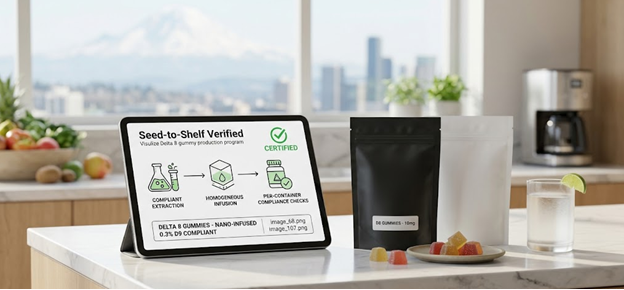
As we navigate the finalized regulatory landscape of March 2026, the American cannabis industry has achieved a critical equilibrium. In no sector is this more evident than with delta 8 gummies. For years, these products operated in a legal “hemp loophole” created by the 2018 Farm Bill, leading to market fragmentation and widespread consumer confusion. Today, however, following robust state-level enforcement throughout 2025, the definition of a compliant delta 8 gummy has been standardized, prioritizing exact milligram caps, verified production methods, and pharmaceutical-grade safety requirements. Navigating this mature market in 2026 requires understanding the pillars of quality and compliance.
Best THCA Deals Here: – https://thcaking.com/products/bulk-thca-smalls
Regulatory Standardization and the Per-Container Cap
The most significant transition for delta 8 gummies over the past two years has been the shift from “dry weight” calculations to strict per-container limits. In the early 2020s, a manufacturer could produce a highly potent gummy simply by increasing its size to remain below the 0.3% Delta-9 threshold. This approach created substantial safety concerns for regulators.
In 2026, most states now impose a mandatory maximum milligram cap per container (often totaling 0.4mg of Total THC per retail unit, defined as Delta-9, Delta-8, and other intoxicating isomers). This regulation means that a standard 2026 retail pouch, typically containing 10 or 20 gummies, will offer micro-dosing strengths (such as 1mg or 2mg of Delta 8 per gummy). This approach ensures that these products, sold outside of state-licensed dispensaries, provide a predictable, functional experience rather than unintended high-potency impairment.
Production Integrity and Homogeneous Infusion
A quality delta 8 gummy in 2026 is defined by its manufacturing precision. The early market was flooded with inferior products created using the “Spray-On” method, where generic candy was simply misted with cannabinoid distillate. This often resulted in inconsistent dosing and dangerous “hot spots” within a single batch.
Premium 2026 gummies utilize advanced “Seed-to-Shelf Verified” protocols. This means:
- Homogeneous Infusion: The Delta 8 distillate is thoroughly mixed into the gummy base—increasingly a plant-derived pectin for superior thermal stability—before the mixture is molded. This technique guarantees that a label claiming 2mg per serving is accurate to within a strict 5% variance.
- 0% THC Delta-9 Clearance: Compliant 2026 gummies must utilize a broad-spectrum or isolate formulation, verifying that all detectable Delta-9 THC has been refined out, ensuring legal compliance even as other potent isomers like Delta-8 are retained.
Verified Lab Practices and Child-Resistant Standards
For consumers navigating the 2026 delta 8 gummies market, transparency is paramount. Safety is governed by mandatory Certificate of Analysis (COA) standards. Every batch of gummies must be third-party tested, with the results easily accessible via a QR code on the mandatory opaque, child-resistant packaging.
A verified COA in 2026 must confirm:
- Precise Total THC Potency: Verifying the specific milligrams per serving.
- Pesticide, Heavy Metal, and Residual Solvent Clearance: Essential for chemically refined extracts like Delta-8.
- Correct Delta 8 to Total THC Ratio: Ensuring the product adheres to the per-container cap logic.
To maintain the product’s validated shelf life, keep your gummies in their child-resistant container in a cool, dark place, ideally below 72°F (22°C). High heat can melt the pectin base and rapidly accelerate the degradation of the active Delta 8 into sedative CBN, altering the carefully engineered effects and potentially voiding the product’s lab certification. …